Hiring a good developer in-house takes time: job posts, screening, interviews, notice periods, onboarding. Then there are salaries, office space, equipment and the risk that the hire doesn’t work out. For many businesses, especially when a project is already waiting, that timeline doesn’t work.
Hiring dedicated developers through a company in India gives you skilled people working full-time on your project, usually within a couple of weeks, without the overhead of permanent hiring. Here’s how it works, what it costs and how to make it succeed.
What “dedicated developer” actually means
A dedicated developer works only on your project, full-time, as an extension of your team. You set priorities and review the work; the provider handles employment, payroll, equipment, office infrastructure, leave cover and replacement if needed. It’s different from a freelancer juggling several clients, and different from handing a fixed scope to an agency.
Engagement models compared
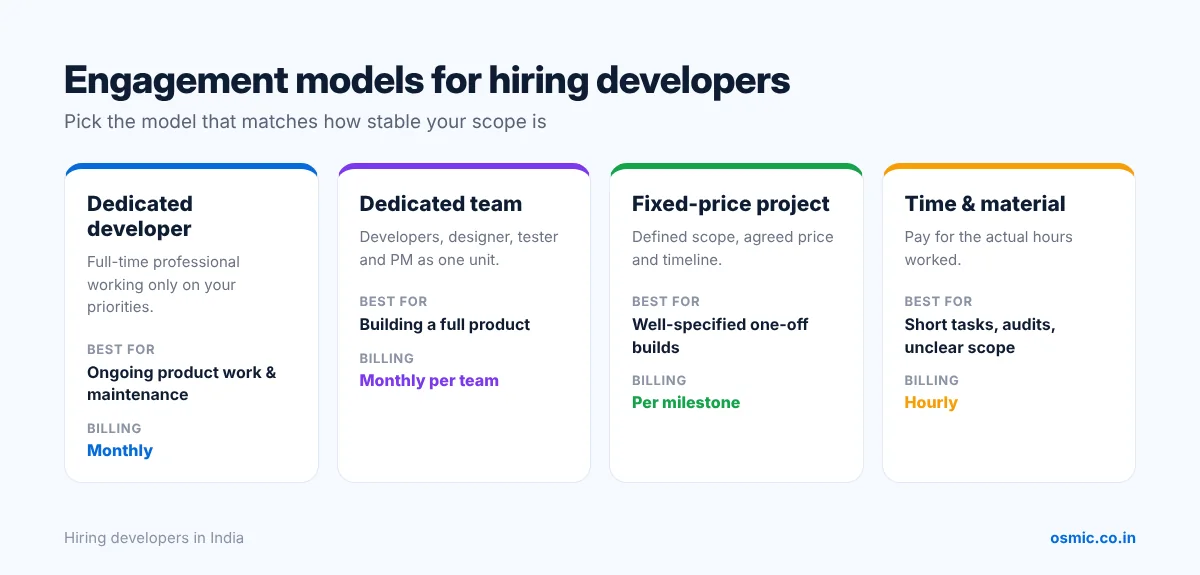
- Dedicated developer (monthly): one or more full-time developers on a monthly contract. Best for ongoing product work, maintenance and evolving requirements.
- Dedicated team: a complete unit (developers, designer, tester, project manager) assembled for your product.
- Fixed-price project: a defined scope at an agreed price. Best for well-specified one-off builds.
- Time and material (hourly): you pay for actual hours. Useful for short tasks, audits or uncertain scope.
How much does it cost? (India, 2026)
Monthly rates for full-time dedicated developers through an Indian company typically fall in these ranges:
- Junior developer (1–2 years): ₹40,000 – ₹70,000
- Mid-level developer (3–5 years): ₹60,000 – ₹1,20,000
- Senior developer / tech lead (6+ years): ₹1,20,000 – ₹2,50,000+
Specialist skills (cloud architecture, DevOps, AI/ML, niche frameworks) sit at the upper end. Longer contracts and multiple hires usually bring better rates. Compare this with the full cost of an in-house hire, including recruitment, salary, benefits, equipment, office space and management time, and the economics are often compelling.
Skills you can hire
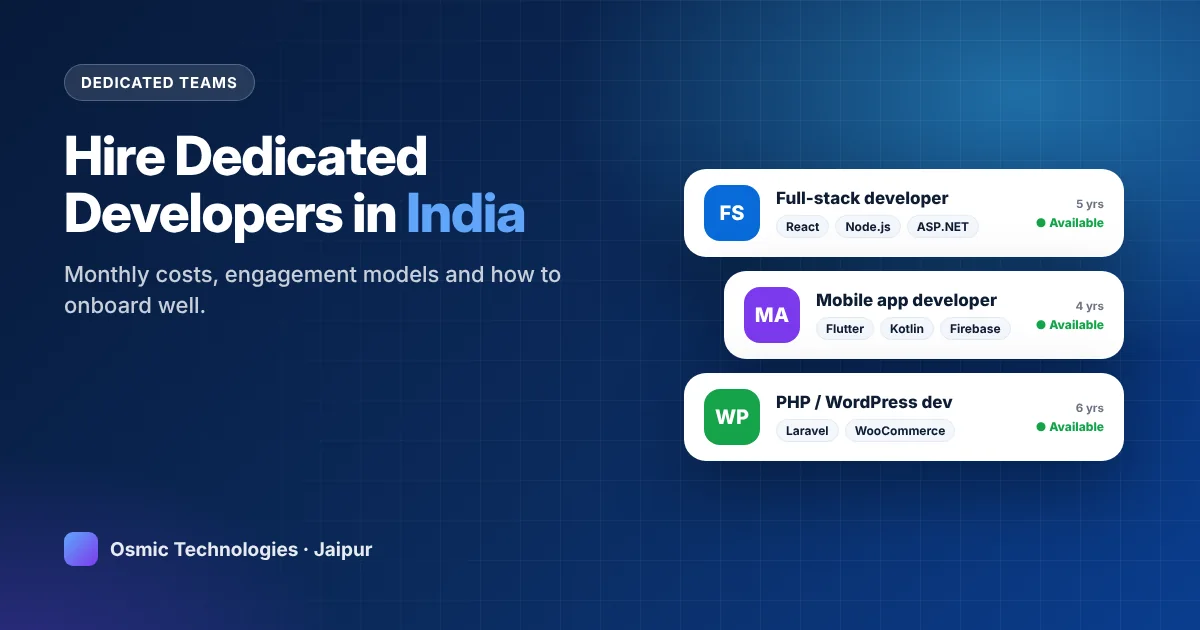
- Web: PHP and Laravel, ASP.NET Core, Node.js, Python and Django, Java
- Front end: React, Angular, Vue, Next.js
- Mobile: Flutter, React Native, Kotlin, Swift
- E-commerce and CMS: WordPress, WooCommerce, Shopify, Magento
- Design and QA: UI/UX designers, manual and automation testers
- Infrastructure: DevOps, AWS and Azure, server administration
The hiring process, step by step
- Share your requirement: skills, experience level, time zone overlap, start date and project context.
- Review profiles matched to your stack, usually within a few days.
- Interview candidates yourself. Include a small practical task or a code walkthrough.
- Sign the agreement with NDA, IP ownership, notice period and replacement terms.
- Onboard: give access to code, tools and documentation, and set the first two weeks’ goals.
- Review regularly: weekly check-ins and a 30-day performance review.
Common mistakes (and how to avoid them)
Hiring on price alone
The cheapest developer often costs the most once rework is counted. Interview for problem-solving and communication, not just years of experience.
No onboarding
Dropping a developer into a codebase without documentation or context wastes weeks. Prepare a short onboarding document and a first task that delivers something real.
Unclear ownership and access
Keep repositories, servers and third-party accounts under your organisation’s ownership. Give access by role and remove it when someone leaves.
Too little communication overlap
Agree on overlapping working hours, a daily update format and a weekly demo. For international clients, a few hours of overlap is usually enough.
No replacement clause
Make sure the agreement covers how quickly a replacement will be provided if a developer leaves or isn’t a fit, and how knowledge transfer will happen.
In-house hire vs dedicated developer: a quick comparison
When you compare a dedicated developer’s monthly fee with an in-house salary, include the whole cost of employing someone:
- Recruitment time and agency fees
- Salary plus benefits, bonuses and statutory contributions
- Laptop, software licences, office space and internet
- Time spent by your managers on HR and administration
- The cost of a bad hire, or of a gap when someone leaves
With a dedicated model, most of these sit with the provider, and replacing a developer is their responsibility. You pay one predictable monthly fee and keep the flexibility to scale up or down.
How to interview remote developers
- Talk through past work: ask them to explain a project they’re proud of, the hardest bug they fixed and what they would do differently.
- Give a small practical task similar to your real work, or review a pull request together.
- Test communication: can they explain a technical decision simply, and do they ask good questions?
- Check overlap and availability: working hours, response times and how they report progress.
A weekly rhythm that works
- A daily written update: done, doing next, blockers
- A short weekly call to review the demo and set next week’s priorities
- Tasks tracked in one tool (Jira, Trello or similar) with clear acceptance criteria
- Code reviews and a staging environment so nothing reaches production unreviewed
- A monthly check-in with the provider’s account manager on quality and fit
Security and IP checklist
- Signed NDA and IP assignment before access is given
- Repositories and cloud accounts owned by your organisation
- Role-based access with individual logins, with no shared passwords
- Production data access only when necessary, and logged
- Access revoked on the same day an engagement ends
When dedicated hiring is the right choice
- You have a product or platform that needs continuous development.
- Your in-house team needs extra capacity for a few months.
- You need a specific skill quickly, such as Flutter, React or DevOps.
- You want to test a remote team before scaling it.
If your project has a small, fixed scope, a fixed-price engagement may be simpler.
Next step
Tell us the skills and experience you need, and we’ll share matching developer profiles for you to interview, with no obligation. Learn more about how to hire dedicated developers or our IT outsourcing services.
Get developer profiles in days
Share your tech stack and we’ll send matching profiles for you to interview.
Hire developers →