Starting an online store in India has never been easier, and choosing how to build it has never been more confusing. One person tells you Shopify is the only sensible option. Another swears by WooCommerce. A developer suggests building something custom.
All three can be right. The best choice depends on your catalogue, budget, how much control you want and where you plan to be in two years. Here’s a straight comparison for Indian sellers in 2026.
The short version
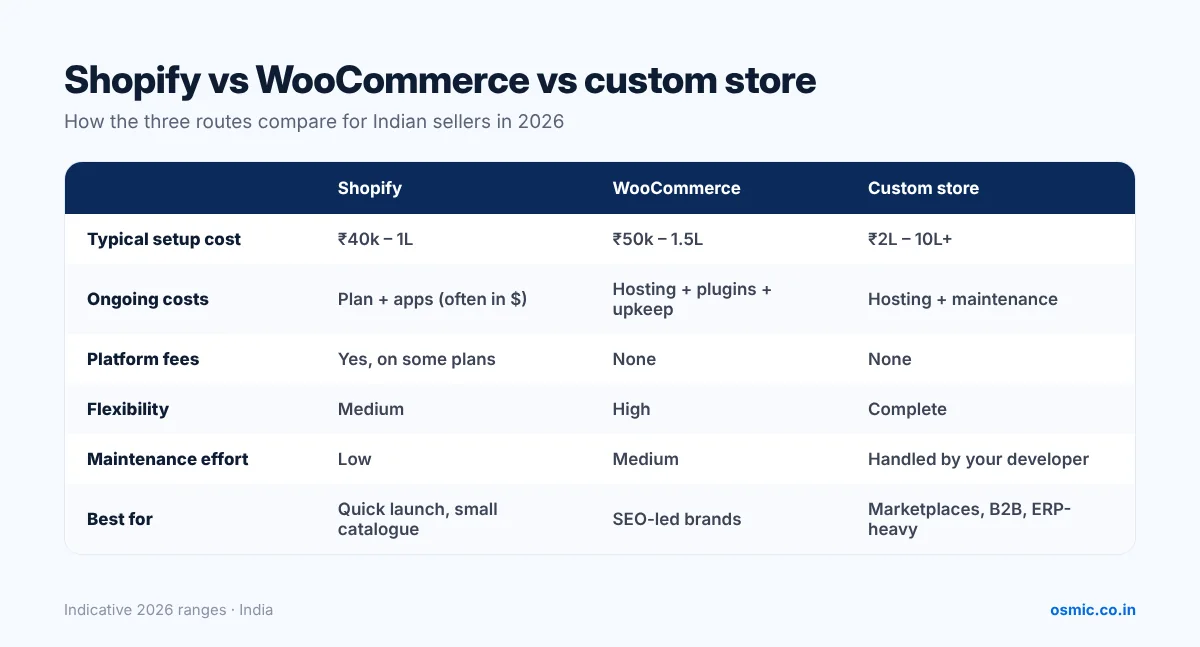
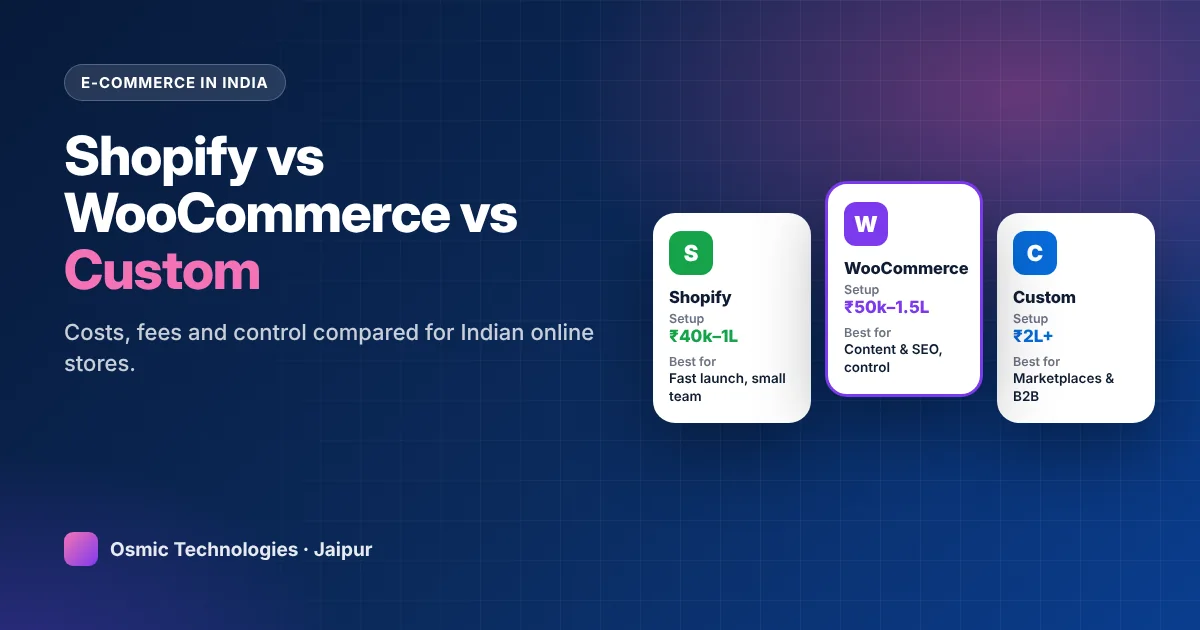
- Shopify suits brands that want to launch quickly, with a small team and no technical headaches.
- WooCommerce suits businesses that want more control, strong content and SEO, and lower ongoing fees, and are happy to look after hosting and updates.
- A custom store suits marketplaces, B2B sellers and businesses whose processes don’t fit a standard platform.
Shopify: fastest to launch, easiest to run
What you pay: a monthly plan, transaction fees on some plans if you use third-party gateways, a theme (free or paid), and apps for things like reviews, GST invoices, WhatsApp alerts and advanced filters. Professional setup with a customised theme typically costs ₹40,000–₹1,00,000.
Strengths: hosting, security and updates are handled for you. The admin is simple, checkout is reliable and there’s an app for almost everything.
Watch out for: app subscriptions quietly add up, and many are billed in dollars. You have limited control over checkout and some SEO details, and moving away later takes real work.
WooCommerce: flexible and content-friendly
What you pay: WooCommerce itself is free. You pay for hosting (choose good hosting, not the cheapest), a theme, a few premium plugins and maintenance. Professional setup typically costs ₹50,000–₹1,50,000.
Strengths: it runs on WordPress, so blogging and SEO are excellent. You own everything, there are no platform transaction fees, and almost anything can be customised.
Watch out for: you’re responsible for hosting, security, backups and plugin updates. A poorly maintained WooCommerce store gets slow and vulnerable, so budget for maintenance from day one.
Custom e-commerce development: built around your business
What you pay: custom stores typically start around ₹2 lakh, while multi-vendor marketplaces, B2B portals and integrated systems range from ₹4 lakh to ₹10 lakh and more.
Strengths: complete control over features, workflow, design and performance. No per-order platform fees and no dependency on app subscriptions, and it can integrate directly with your ERP, Tally, warehouse or logistics partners.
Best for:
- Multi-vendor marketplaces with seller onboarding and commissions
- B2B stores with customer-specific pricing, credit limits and bulk ordering
- Product configurators (custom furniture, printing, jewellery)
- High-volume stores where platform and app fees have become significant
The India-specific checklist (whatever you choose)
- Payments: UPI, cards, net banking and wallets through Razorpay, PayU, Cashfree or PhonePe.
- Cash on delivery with rules: minimum order value, pin-code restrictions and OTP confirmation to cut fake orders.
- GST invoices with GSTIN, HSN codes and the correct tax split.
- Shipping integration with Shiprocket, Delhivery or similar for rates, labels and tracking.
- WhatsApp order updates, which get far better open rates than email in India.
- Mobile speed: most buyers shop on mid-range Android phones over mobile data.
- Return and refund policies that are clear and visible, for customer trust and payment gateway approval.
Your own store or Amazon and Flipkart?
It isn’t either-or. Marketplaces bring ready traffic but charge commissions and control the customer relationship. Your own store builds a brand, repeat customers and better margins, but you have to bring the traffic. Many successful Indian D2C brands sell on both: marketplaces for reach, and their own store for loyal customers, bundles and better margins.
Payments and cash on delivery, done properly
Choose a payment gateway with good UPI success rates, quick settlements and a clean checkout on mobile. Then protect yourself on COD:
- Set a maximum COD order value and block COD for high-risk pin codes
- Confirm COD orders by OTP or an automated WhatsApp message
- Offer a small discount for prepaid orders
- Track return-to-origin (RTO) rates by pin code and adjust rules monthly
SEO for online stores
Ads can launch a store, but organic search keeps it profitable. Make sure your store has unique product descriptions (not the manufacturer’s copy), clean category URLs, product schema for prices and reviews, fast mobile pages, compressed images, and helpful buying guides on the blog. Category pages often rank better than individual products, so write useful content for them too.
Pre-launch checklist
- Test checkout on Android and iPhone, with UPI, card and COD
- Check GST invoices and tax calculations on sample orders
- Set up order, shipping and delivery notifications by email and WhatsApp
- Publish shipping, return, refund, privacy and terms pages
- Connect Google Analytics, Search Console and Merchant Center
- Install the Meta pixel and conversion tracking for ads
- Run a speed test on mobile and fix the slowest pages
Total cost of ownership over three years
Don’t compare only the build price. Add up three years of platform fees, apps or plugins, hosting, payment charges, maintenance and expected changes. A store that’s cheaper to launch can be more expensive by year three, and the reverse is also true. Ask your developer to model both scenarios for your expected order volume.
Our honest recommendation
- Testing a new product line with under 50 products? Shopify gets you selling in weeks.
- Content-led brand, SEO-focused and cost-conscious? WooCommerce, with good hosting and a maintenance plan.
- Marketplace, B2B, complex catalogue or ERP-heavy operations? Custom, planned in phases so you launch early and grow.
Next step
Not sure which route fits your business? Share your catalogue size, expected orders and must-have features, and we’ll recommend a platform with a clear cost comparison. See our e-commerce development services or, for marketplaces, our portal development work.
Get a platform recommendation for your store
We’ll compare Shopify, WooCommerce and custom for your catalogue and order volume, and quote all three.
Get free consultation →